Chain Link vs. Iron vs. Wood: Which Commercial Fence Is Best for Your Property?
When it comes to the question of chain link vs. iron vs. wood, choosing a commercial fence is not just about deciding which material looks best.
The right fence depends on what you need it to do.
Some commercial properties need strong perimeter security. Others need privacy, controlled access, a professional appearance, or a combination of all three. The fence around a warehouse may serve a completely different purpose than the fence around an apartment community, school, office building, or retail property.
At Texas Fence, we help commercial property owners look at the full picture before choosing a fence system. That means considering security, visibility, maintenance, gates, appearance, traffic, and how the property is used every day.
Chain link, iron, aluminum, and wood can all be good choices for commercial fencing. The better question is which material makes the most sense for your specific property.
Start With What the Fence Needs to Accomplish
Before comparing materials, we recommend identifying the main purpose of the fence.
Are you trying to:
- Secure equipment or inventory?
- Control access to the property?
- Keep customers or visitors away from restricted areas?
- Add privacy?
- Improve the appearance of a customer-facing property?
- Separate different parts of a commercial site?
- Enclose a pool or recreational area?
- Create safer pedestrian or vehicle traffic?
- Add automatic gates or access control?
Many commercial properties need more than one of these things.
That is why the best commercial fence system is not always one material around the entire property. So it is not always just a matter of chain link vs. iron vs. wood for you fence choice.
A business may use decorative metal fencing along the street, chain link around a storage area, and a privacy fence around dumpsters or mechanical equipment.
The fence should match the job.
Commercial Chain Link Fencing
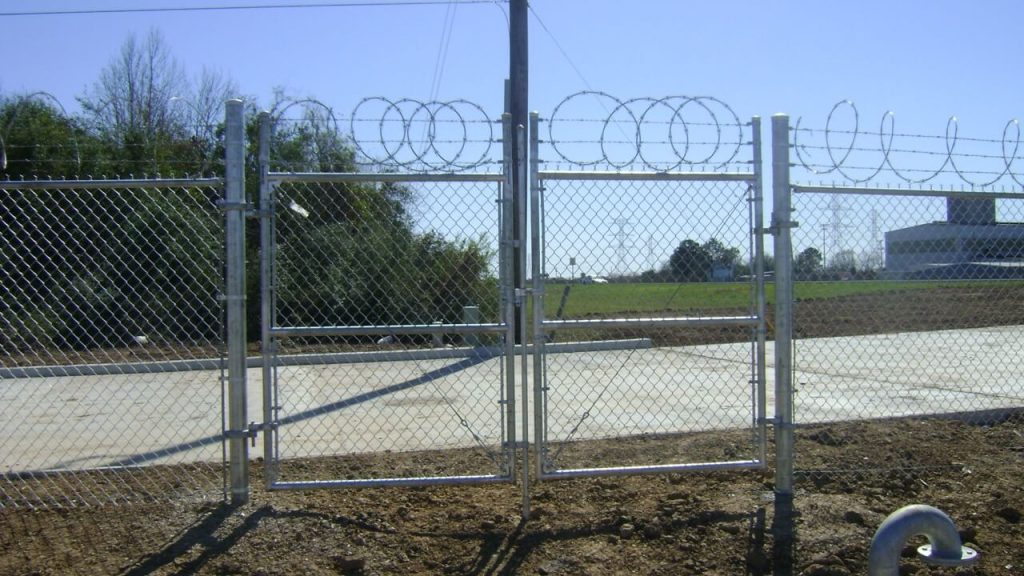
Chain link is one of the most common choices for commercial and industrial properties because it can secure large areas efficiently.
It is often used around:
- Warehouses
- Distribution facilities
- Equipment yards
- Industrial properties
- Construction sites
- Schools
- Athletic facilities
- Storage facilities
- Utility areas
- Commercial back lots
Commercial chain link fencing provides visibility through the fence while creating a clear physical boundary.
That visibility can be useful on properties where employees, security personnel, or cameras need to see what is happening on both sides of the fence.
Internal link: Commercial Chain Link Fence Installation
When Chain Link Makes the Most Sense
Chain link is usually a strong option when the main priorities are security, function, and controlling the project budget.
It can also be adapted to different levels of security.
Depending on the project, chain link fencing may include taller heights, heavier materials, privacy slats, windscreens, security features, gates, or access control systems.
This makes it useful for everything from a basic commercial boundary to a more controlled industrial perimeter.
For large properties with long fence runs, chain link can also make it possible to secure more of the site without spending the same amount that may be required for decorative metal fencing.
Where Chain Link May Not Be the Best Choice
Chain link is practical, but appearance is not always its strongest advantage.
A business with a highly visible entrance may want something more finished along the front of the property.
For example, an office building, apartment community, church, retail center, or upscale commercial development may want a fence that becomes part of the property’s overall appearance.
In those situations, we may recommend another material for the public-facing sections while still using chain link in less visible areas.
Commercial Iron and Aluminum Fencing
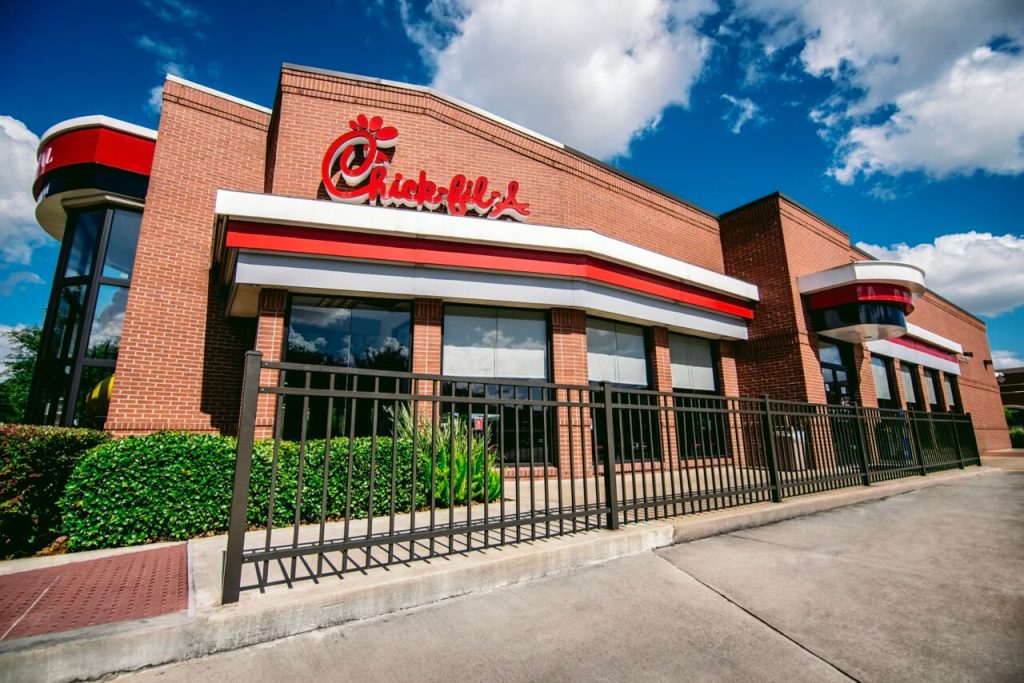
Iron and aluminum fencing are often chosen when appearance matters along with security.
These fences can create a cleaner, more architectural look than standard chain link.
They may be a good fit for:
- Apartment communities
- Office buildings
- Retail properties
- Schools
- Churches
- HOA properties
- Pool areas
- Commercial entrances
- Public-facing facilities
- Higher-end developments
Metal fencing can define the property without creating a solid visual barrier.
That can be important when a business wants to improve security without making the property feel closed off.
Why Businesses Choose Decorative Metal Fencing
One of the biggest reasons to choose iron or aluminum is appearance.
The fence can become part of the overall design of the property.
This is especially important along entrances, sidewalks, parking areas, landscaped areas, and other locations customers or tenants see regularly.
Metal fencing also works well with gates.
A matching pedestrian gate or vehicle gate can create a consistent look across the property while still providing controlled access.
Internal link: Commercial Fence Installation
Iron vs. Aluminum for Commercial Properties
Iron and aluminum may look similar from a distance, but they are not the same material.
The right choice depends on the project.
Some properties may benefit from the strength and feel of iron or steel fencing. Others may prefer aluminum because it can provide a decorative appearance with different maintenance considerations.
The exact design, height, spacing, gate requirements, and surrounding structures also matter.
Rather than choosing based only on appearance, we recommend looking at how the fence will be used.
Will it be installed near heavy traffic?
Will vehicles operate close to it?
Is it mainly decorative?
Does it need to control access?
Will it connect to automatic gates?
Those questions can help determine which metal fencing system makes the most sense.
Commercial Wood Fencing
Wood fencing solves a different set of problems.
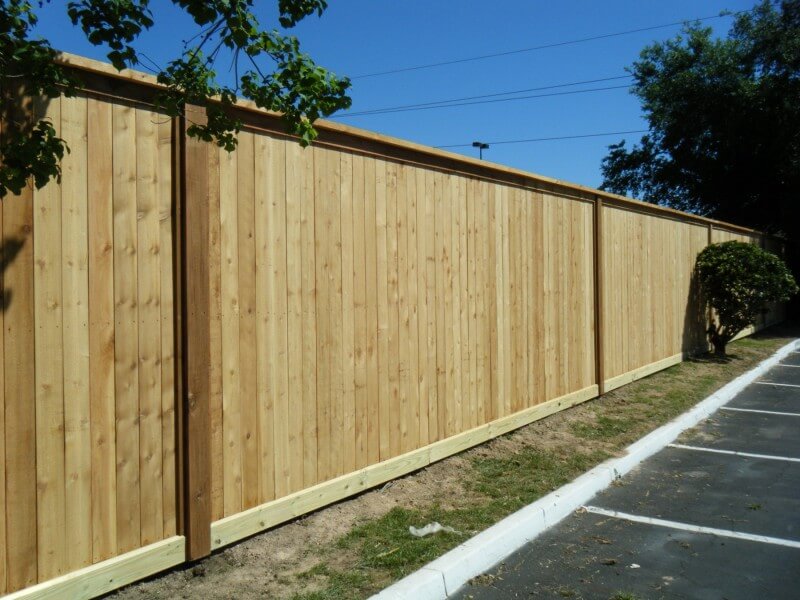
Unlike chain link and open metal fencing, wood can create a solid visual barrier.
That makes it useful when privacy is the main concern.
Commercial wood fencing may be used around:
- Apartment communities
- Restaurants
- Outdoor employee areas
- Dumpster enclosures
- Equipment areas
- Mechanical systems
- Storage areas
- Residential-facing commercial boundaries
- Properties that need visual screening
A wood fence can help hide areas that customers, neighbors, or nearby properties do not need to see.
When Wood Is the Better Choice
Wood is often the better option when blocking visibility matters more than maintaining an open view.
Imagine a restaurant with an outdoor customer area next to dumpsters and service equipment.
A chain link fence might technically separate the areas, but it would not block the view.
A wood privacy fence can.
The same idea applies to apartment properties, commercial storage areas, equipment yards, or businesses located next to residential neighborhoods.
Privacy can sometimes be just as important as security.
Maintenance Should Be Part of the Decision
Commercial property owners should think beyond installation day.
Every fence is exposed to weather, soil conditions, landscaping, vehicle traffic, equipment, and regular use.
The maintenance needs can vary by material.
Wood may eventually need staining, sealing, repairs, or board replacement.
Chain link systems can require repairs if fabric, posts, gates, or hardware are damaged.
Metal fencing may need attention to coatings, hardware, gates, or damaged sections depending on the material and environment.
Gates often require even more attention because they move.
A fence section may sit in the same place for years.
A commercial gate may open and close many times every day.
That makes the quality of the gate, hinges, rollers, operators, hardware, and installation especially important.
Security Requirements Can Change the Best Material
Not every business needs the same level of security.
A small office property may simply want to create a clear boundary.
An industrial facility may need to restrict access to equipment, vehicles, materials, or sensitive areas.
A school may need to control where students and visitors can enter.
An apartment property may need to manage both pedestrian and vehicle access.
These different situations can lead to very different fence designs.
Chain link may make sense around a large industrial perimeter.
Decorative metal fencing may be better around an apartment entrance.
A solid privacy fence may work better around an equipment area.
The security plan should come before the material decision.
Do You Need Privacy or Visibility?
This is one of the easiest ways to narrow down the options.
If you need visibility through the fence, chain link or open metal fencing will usually make more sense.
If you need to block the view, wood or another privacy system may be more appropriate.
Visibility can be helpful around parking lots, schools, industrial properties, and other locations where staff or security systems need a clear line of sight.
Privacy is more useful around equipment, dumpsters, storage, employee areas, or properties next to homes.
Some businesses need both.
In those cases, mixing materials may produce a better result than forcing one fence type to handle every part of the project.
Gates and Access Control Matter Too
The fence is only one part of a commercial perimeter.
You also need to decide how people and vehicles will get through it.
Commercial properties may need:
- Pedestrian gates
- Employee entrances
- Customer entrances
- Delivery access
- Emergency access
- Equipment gates
- Automatic vehicle gates
- Keypads
- Card readers
- Remote controls
- Intercom systems
- Other access control options
A good fence plan should consider these access points from the beginning.
Adding gates as an afterthought can create problems with traffic flow, security, or the way the property operates.
We look at who uses the property, what types of vehicles need access, how often gates will operate, and which areas need tighter control.
Which Fence Is Best for a Warehouse or Industrial Property?
For many warehouses and industrial sites, chain link is often the starting point.
These properties may have long perimeter runs and need visibility, security, vehicle gates, or controlled access.
Decorative metal fencing may still be used at the front entrance where appearance matters more.
Privacy fencing may be added around certain equipment or storage areas.
A mixed system can often solve the needs of the property better than using the same material everywhere.
Which Fence Is Best for an Apartment Community?
Apartment communities often need a combination of appearance, security, privacy, and access control.
Decorative metal fencing can work well around entrances, pools, and other visible areas.
Wood fencing may provide privacy around dumpsters, equipment, or boundaries near neighboring properties.
Automatic vehicle gates and pedestrian access systems may also be an important part of the project.
The goal is not simply enclosing the property.
It is controlling access while maintaining an appearance that fits the community.
Which Fence Is Best for a School or Church?
Schools and churches often have several different areas that need fencing.
Parking lots, playgrounds, athletic areas, courtyards, equipment areas, and property boundaries may all have different requirements.
Chain link can be practical around large recreational or perimeter areas.
Decorative metal fencing may work better around entrances and highly visible parts of the property.
Gate placement is especially important where there is a mix of vehicle and pedestrian traffic.
Which Fence Is Best for Retail and Office Properties?
Appearance usually carries more weight on a customer-facing property.
An ornamental iron or aluminum fence may fit the property better than standard chain link along visible areas.
That does not mean the entire property needs decorative fencing.
Chain link may still be a smart choice behind the building or around utility and storage areas.
Wood may be useful where dumpsters, equipment, or service areas need screening.
Matching each area with the right fence can provide a professional appearance without unnecessarily increasing the cost of the entire project.
Sometimes the Best Commercial Fence Is More Than One Fence
Commercial properties are rarely simple rectangles with the same needs on every side.
The front may need to look good.
The back may need stronger security.
One side may border another business.
Another side may face homes.
There may be vehicle entrances, employee gates, loading areas, equipment yards, dumpsters, or public walkways.
Trying to solve all of those problems with a single fence material can create compromises.
Instead, we can design a system where each section serves a specific purpose.
That may mean chain link for security, ornamental metal for appearance, wood for privacy, and automatic gates for controlled entry.
The result can be a better-performing fence system and a smarter use of the project budget.
Get Help Choosing the Right Commercial Fence
When it comes to Chain Link vs. Iron vs. Wood, there is no single commercial fence material that is best for every property.
Chain link works well when security, visibility, and value are major concerns.
Iron and aluminum fencing can provide security with a more finished appearance.
Wood fencing can create privacy and visual screening where an open fence would not solve the problem.
The right answer depends on the property, the people who use it, the areas that need to be secured, the amount of privacy needed, and how customers and vehicles move through the site.
At Texas Fence, we can evaluate those needs and help design a commercial fence system around the property rather than trying to fit the property around a standard fence package.
If different areas of your property have different security, privacy, and appearance needs, why should they all be fenced the same way?